Learn more about our story!
History of the Hungária Yacht Club in Balatonfüred
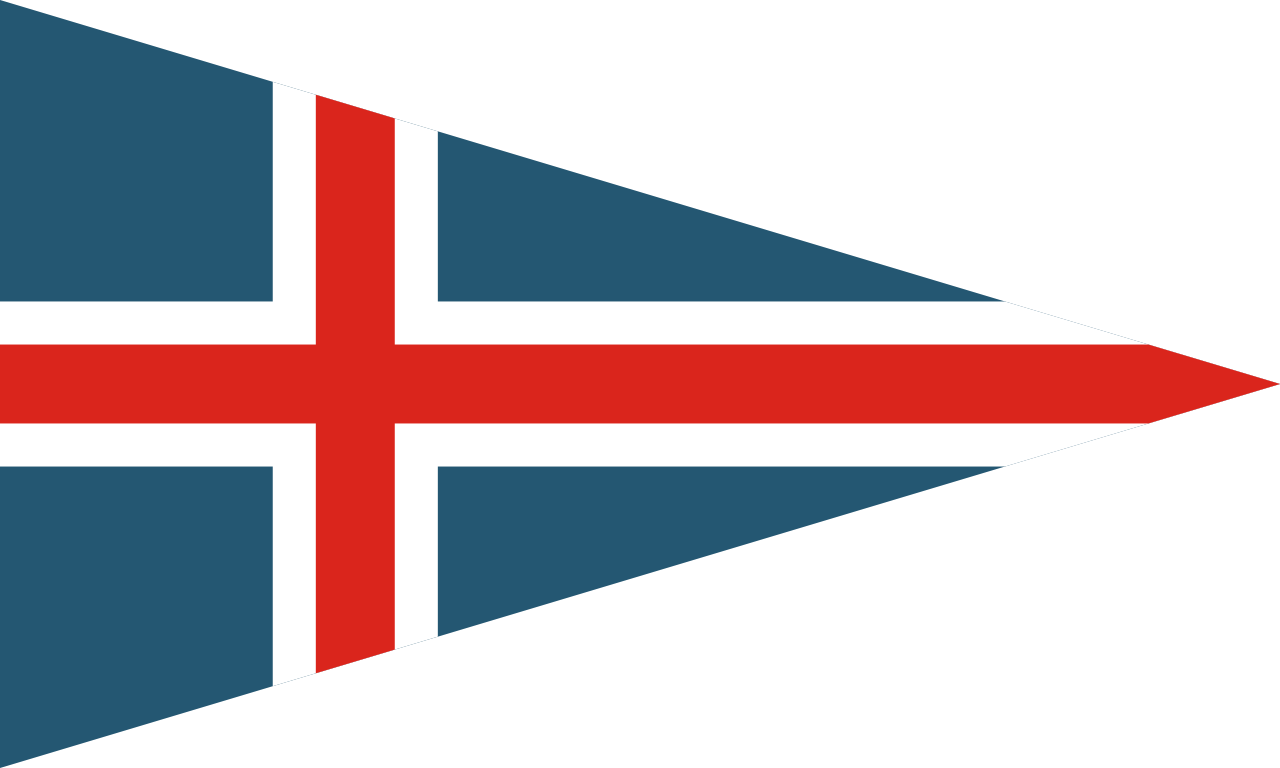
The Hungária Yacht Club (HYC.) was founded in 1933 on the initiative of János Grofcsik and Dr. Miklós Tuss, sailing sailboat racers.The founding members were Jenő Hankóczy (world-famous scientist of flour experiments, first director of the Grain and Flour Experimental Station.
In 1905 he invented the farinometer, the first instrument to measure the elongation of pasta and chicory. In 1912, he developed this further and created the farinograph flour tester and grading instrument, which simultaneously determined the water absorption capacity of flour, the quality of the chicory, the time of dough development, etc. His method and invention spread throughout the world. He initiated the introduction of the national wheat register and the spread of quality wheat cultivation.) as president, Dr. Győző Kemény as vice-president, János Grofcsik as club captain, Dr. Miklós Antal as secretary, Ferenc Káldy and Arnold Krayer-Krausz, all of them top sailing athletes, and the boat designer of the Balatonfüred Sportboat Plant: Benacsek, later Jenő Hankóczy.
Klaszek, later Ödön Kaposi, also an active sportsman, who was instrumental in obtaining and organising the club’s foundation, later Ödön Kaposi, who was also active in the sport, later became a member of the club.
The founders’ idea is to intensify the competition. Therefore, the membership, which was capped at 50 members, was based on active sporting activity and whether the member had to own a boat or be a “manchaft” in a class. The original stipulation that women could be members had to be disregarded because of the involvement of women in sailing, but the number of 50 members could not be increased, and the original stipulation that women could be members had to be disregarded because of the involvement of women in sailing – the acquisition and maintenance of boats by members at their own expense was a very considerable financial burden for the benefit of sailing – and therefore the number of members never reached 50.
The newly founded Club did not even have a clubhouse at the beginning, and at the time of its foundation it was claimed that there was no need for one, that the sport could be managed without a clubhouse.
It soon became clear, however, that it was difficult to keep a club together without a clubhouse. So the Krayer brothers bought a small plot of land on the sailing island behind the MAC house in Siófok, with the idea of building a modest wooden structure. This solution was torpedoed by Grofcsik, Benacsek, Dr. Tuss and Káldy and a resolution was forced out of the board of directors that the clubhouse could only be built in Balatonfüred, justifying this by the fact that most of the members had capital boats. The north coast is more favourable for this class of boats. However, the acquisition of a clubhouse was difficult because only land owned by Tihany Abbey could be considered. It seemed almost hopeless to secure a waterfront plot from Tihany Abbey for such a purpose, not to mention the fact that the club membership did not have the financial means to pay for a waterfront plot.
However, a stroke of good fortune intervened, due to the misfortune of the Balaton Yacht Club.


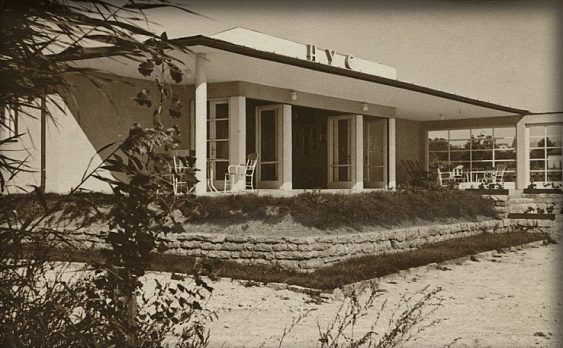
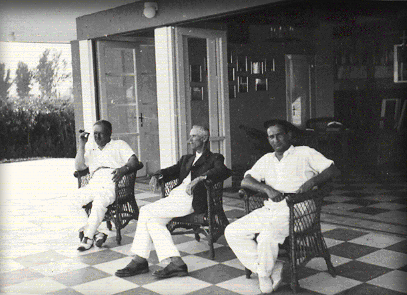
The history of the BYC in Fured is a calvary around the construction of the BYC clubhouse and the approval of its construction. The BYC rightly accused the bathing governor of the Order of St Benedict of Balatonfüred of being against sport. At the time of that accusation, the management of the Hungária Yacht Club (HYC) came knocking at the door of the governor of the baths, asking him to lease a plot of waterfront land owned by the Order, at a location indicated by the Order, for the purpose of building a clubhouse. In order to get back to BYC, the Governor of the Baths of Gachacs, who has stated that he is not engaged in any anti-sporting activity, has complied with HYC’s request. For a 90-year lease for a token amount of cca. For a 90-year lease, for a nominal sum of 400 square metres, he made available to HYC a plot of land south-west of the sports boat facility, the area which until 1998 was previously owned by BKV.
When HYC was given this area, it was almost inaccessible. It was a reedy, muddy area where you couldn’t even stand on 1 square metre of dry land. The contract could not be considered very favourable, given the clauses it contained. The most notable was the clause that neither members nor their relatives could bathe there, not even from their boats, no food could be prepared there, and members could only be served food brought there from the Order’s institutions. If the Club breaches this clause, the Clubhouse building and its equipment shall become the property of the Order without compensation. But HYC also had a lawyer, Miklós Antal, the club secretary, who calmly accepted these clauses, saying that the court would not uphold them as immoral. After the acquisition of the land, there was great joy among those who had fought for HYC’s relocation to Balatonfüred. Now there was a muddy reed bed, but not a penny for filling it up or building it.
HYC has been granted permission to transport fill material from the former sports field /former ABC site/ opposite. Ferenc Káldy and Jenő Benacsek, bidding against each other, agreed to deliver more and more filling material to the site and with the financial commitment of the other members, by delivering about 1000 m3 of earth to the site, it could be said that now it was possible to stand on the land with dry feet. However, a further difficulty and expense was caused by the planned building and its costly foundations, given the muddy ground.
The design work was undertaken free of charge by Ferenc Káldy, a local architect and contractor, who had a major role in the construction of the entire clubhouse. – According to János Grofcsik, it was thanks to his sacrifice that the clubhouse was built. For the members, maintaining their own boats was a considerable expense, and for most of them it meant exhausting their financial resources.
In the autumn of 1933, the foundations of the oak piles of the clubhouse building were laid, and in June 1934, with great enthusiasm and in the presence of the fellow clubs, it was consecrated by the Abbot of Tihany, Strommer Victorin himself, with the inscription “navigare necesse est” painted on the pine beam of the lounge (which was later replaced, after nationalisation, by the inscription “Honour the people’s democracy has given you”)…
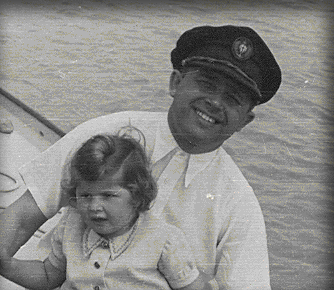

A Klubház megnyitója

Club tagok a 30-as években.
Középen Dr Tuss Miklós
As we will see later, HYC showed not only here what they can produce from their love of sport, by pulling money out of their pockets, but also from their sporting achievements. The clubhouse became a veritable home for the entire membership, with all members rushing to spend their holidays here, but also providing a loving welcome to other club members on the tour.
With regard to the financial costs, it should be mentioned that only a loan of 5 000 pence was raised, thanks to the guarantee of Dr. Tuss, Káldy and Krayer. At the same time the Kir. Hungarian Yacht Club /KMYC/ received a 20.000.- Pengler non-repayable grant from the sports authority of the time for the extension of the clubhouse in Balatonfüred.
The cost of building the HYC clubhouse was 25.000.- pengo, which was paid entirely by the members out of their own pockets, most of it, as mentioned above, by Ferenc Káldy. The fraternal fellowship and devotion to sailing racing that existed in HYC attracted many members from KMYC, because KMYC had first, second and third class members, while HYC had always been democratic. The other clubs benefited from HYC’s performance. HYC broke the hegemony of KMYC, pulling the competitors of the other clubs with its sporting performance. It was not long before a newly founded club with the same number of members as KMYC, which had hitherto determined the exclusivity of the sport of sailing by a decisive majority, was on the board, leading to a decline rather than a boom in sporting activity.
HYC founded the Balaton Blue Ribbon Race, which is held every two years and was first held on 27 July 1934. The first course of this race was Balatonfüred-Keszthely-Balatonfüred. Later on, the first race was Balatonfüred – Keszthely – Balatonkenese – Siófok – Révfülöp – Keszthely – Tihany. In the first race Germany also participated with a 30 cod cruiser, winning a very good second place, while the first place was won by Gábor Ugron, with a 30 cod cruiser named RABONBÁN. The second race was won by Béla Kovács, with a dinghy 22, which is a special sporting achievement from a dinghy-sailing section.
The winner of the blue ribbon race won the HYC prize, and was also awarded the HYC blue ribbon at the top of his mast until he lost first place in the next race. The excellent achievement of János Grofcsik, who held the Kenese-Keszthely distance record for many years with his 22-weight capital cruiser SIROCCÓ, should also be mentioned here.
Extending the Balaton season has always been a big problem. They wanted to achieve this in a proper way by placing various competitions at the end of the season, from 1 to 10 September. In Siófok there were horse races, sailing races, in Balatonfüred tennis and fencing races, etc. These races included a speed race on the Siófok – Balatonfüred or Balatonfüred – Siófok course, at a time of anyone’s choice within 10 days.
Ferenc Káldy, with his 22-man racing cruiser KARI and László Farkas as crew, took part in this race in 1936, during a storm in the north, when the Balaton shipping service stopped its sailings, with the result that it was impossible to sail on Lake Balaton. Káldy then set a record of 43 minutes and 47 seconds for this distance, a record he still holds 40 years later.
It is worth mentioning here that the cruising time for motor boats on Lake Balaton over this distance is 55 minutes.
The club’s race results are typical, from the available data, of the 1940 statistics, which are work statistics:

| Ranking | Club | Point | Number of seats |
|---|---|---|---|
| 1. | HYC | 8789 point | 23 competitor |
| 2. | BYC | 6782 point | 23 competitor |
| 3. | SBE | 3625 point | 21 competitor |
| 4. | KMYC | 3016 point | 20 competitor |
| 5. | TYC | 1877 point | 9 competitor |
| 6. | MAC | 1589 point | 14 competitor |
| Place | Club | Point | Number of seats |
|---|---|---|---|
| 1. | HYC | 8789 point | 23 competitor |
| 2. | BYC | 6782 point | 23 competitor |
| 3. | SBE | 3625 point | 21 competitor |
| 4. | KMYC | 3016 point | 20 competitor |
| 5. | TYC | 1877 point | 9 competitor |
| 6. | MAC | 1589 point | 14 competitor |
These figures are similar for previous and recent years. HYC has always been ahead in terms of race results. When there were five championships, HYC won four of them, then five out of seven and seven out of nine. With these results, HYC has had a great influence on the competitors of other clubs and it can be said that HYC has been a great boost to the competitive sailing of other clubs.
However, HYC has also set an example in the field of touring sailing. With the participation of its members, every year it organised a 10-day sailing tour, the first of which started in 1935, always combined with the various boat class races organised by the Kesztelyi Yacht Club in Keszthely.
Thus, the HYC had a very effective influence on the more lively sailing races in the eastern part of Lake Balaton and the slower ones in the western part of Keszthely, and at the same time propagandised the sport of sailing.
Példamutató tevékenységet fejtett ki azonban a HYC a túra-vitorlázás terén is. Tagjainak részvételével minden évben 10 napos túra-vitorlázást rendezett, mely túra elsőnek 1935. évben indult, Keszthelyen mindig összekötve a Kesztelyi Yacht Club által rendezett különböző hajóosztályú versenyekkel.
Így a Balaton keleti részén élénkebb és a nyugati, keszthelyi részen lanyhább vitorlás-versenyzésre is a HYC igen eredményesen hatott és egyben propagandát fejtett kis a vitorlás sport érdekében.
- METEOR capital heavy with Jenő Hankóczky
- NEMERE 40-es versenycirkáló Berzsenyi Zoltánnal
- Cruiser KABALA I. 22 with Ernő Gallus
- NYÍL 22 racing cruiser with Lajos Jalsoviczky
- KARI 22 cod-weight racing cruiser with Ferenc Káldy
- LUCIFER I. 22 racing cruiser with Krayer-Krausz Arnold
- SIROKKÓ 22 racing cruiser with János Grofcsik
- KABALA II. 30 racing cruiser with Dr. Miklós Tuss
- ZULU and VÉNLEGÉNY yollék
- LIDÉRC motorbike with Lajos Kerekes
The first president of HYC, Jenő Hankóczy died in 1939. Although he was a resident of Budapest, his coffin was covered with the HYC flag and placed in the Csopak cemetery in accordance with his will.
He was followed by János Iklódi Szabó, /President of Balaton Fishing Company/, a sailor since childhood, who raced with his two sons and daughter Éva in a 30-weight cruiser. Originally a member of KMYC, he was also brought over by the sailing spirit of HYC. Iklódi was at the head of HYC for a short time, because after a few years as president, his coffin, also draped with the HYC flag, was moved to the Lower Ores cemetery.
Iklódi was succeeded in the presidency by Dr. Zoltán Berzsenyi, owner of the boat NEMERE 40. Berzsenyi was the director and distinguished surgeon of the St. George’s Hospital in Székesfehérvár, whose life was spent between the clubhouse and the hospital. He spent all his free time at the club, a lover of sailing since childhood. During the war, he was killed by a bullet at the siege of Fehérvár. According to his wishes, he was buried in the crypt in the garden of his hospital, which he had built in advance. He was buried without the Club’s banner, after conditions at the time made it impossible for the Club membership to pay their respects at his grave, as they had at those of his predecessors.
In 1938 Berzsenyi began to organise a sailing tour of the Adriatic. His idea and plans were to take the entire club membership down to the Adriatic in 1939 on a chartered sailing boat. Just as the war upset many plans, so the outbreak of war in 1939 made this impossible. Just as President Hankoczy had been shacked up with sailor Kacziáner on his boat METEOR, the same could be said of Berzsenyi. He had only two lives, the hospital and the sailing ship NEMERE.
The war also hit the club hard. But with the end of the war, the club was reinvigorated and sought to take up the place it had once held.

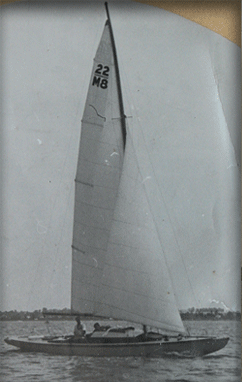
In 1945, the presidency was again held by Dr. Miklós Tuss, who perhaps even surpassed his medical profession with sailing. He had been a sailor since childhood and owned about 10 different boats, whose boat-building ambitions also put our boat designer Benacsek /Hankóczy/ to the test. He started sailing with dinghies, his last boat being the R yacht TALISMAN 6.
Tibor Heinrich, the most successful racer on Lake Balaton, who lived only for sailing, including ice sailing, beyond his civilian profession, was a worthy partner in the change of boatbuilding. At that time, he also came to HYC from KMYC for the reasons already mentioned. At the same time, he sailed three classes of yachts, a 22 dinghy with the KISANGYALOM, an Olympic dinghy with the FABABA, and a 30 cod-weight cruiser named KÉKMADÁR. We know of a nice episode concerning its christening.
The christening of the boat took place in a ceremony at the HYC clubhouse. The women appeared in evening dress, the men in white trousers and blue jackets, yacht attire. After the champagne naming ceremony, in an uplifted mood, Mrs. Ödön and Mrs. Ottóné Henger Deér embraced Káldy by throwing her into Lake Balaton in yacht attire. They set off with him on the narrow jetty, but he did not take their plan seriously. In the middle of the jetty he did see the ladies change their minds, pull their hands out of their arms and turn back. But as they turned, Mrs. Deérné gave him a sudden shove, and he flew over the water in an arc. At the last moment, however, he caught her arm, and she flew with him in her evening dress into Lake Balaton, treading water and mud up to her waist. And so the boat-christening went on in a very good mood. – According to Heinrich, he owed his many excellent results with his boat KÉKMADÁR to this christening.
After the war, in 1947, HYC was dissolved after the dissolution of the social associations.
The clubhouse was given to the ELŐRE sports club in Budapest. HYC members also dispersed, none of them becoming members of ELŐRE.
Of the excellent competitors, Tibor Heinrich, who was perhaps the greatest talent in the sport of sailing on Lake Balaton, was sent to Austria. There, as a member of the Austrian Yachting Association, he continued to reap European victories in his capital boat and was buried in the Maria-Wörth cemetery. The Austrian Yachting Federation has made a beautiful bronze memorial over his grave, with the boat he raced on for the last time, and the inscription on his grave: “To our friend Tibor, known and loved by all from the beautiful Lake Balaton to the blue Adriatic.”
Krayer-Kraus Arnold, also an excellent welterweight competitor, was brought to Brazil with his wife, who was his competitor. On Lake Balaton he was the LUCIFER I, later LUCIFER II. His brother Erich went to Canada – Béla Szalkai to the USA, who was also a famous motorcycle racer. – Ödön Deér, a KABALA II. 30 racer, went to Switzerland, his younger brother József Deér also went to Switzerland, where he became a university professor, and raced with his wife on a 25cc touring scooter, the VIKING. The Turner boys from Sopron – Káldy’s menschaft and Vilmos Weisz in the capital weight were sent to the USA – István Skodai /Schuler/ of EMESE 30, László Rubsich and his sons of DETTA 50 were sent to Austria. Thus scattered, but also making a place for themselves out there.
A few old HYC members, among them János Grofcsik, as age president, sometimes met on Sundays, the topic always sailing, looking back on HYC. – Children of HYC members got involved in sailing, among them the son of Dr. Miklós Tuss, Jr. Miklós Tuss.
The following is a list of HYC members who have competed at the top level for many years and delivered the excellent results mentioned above:
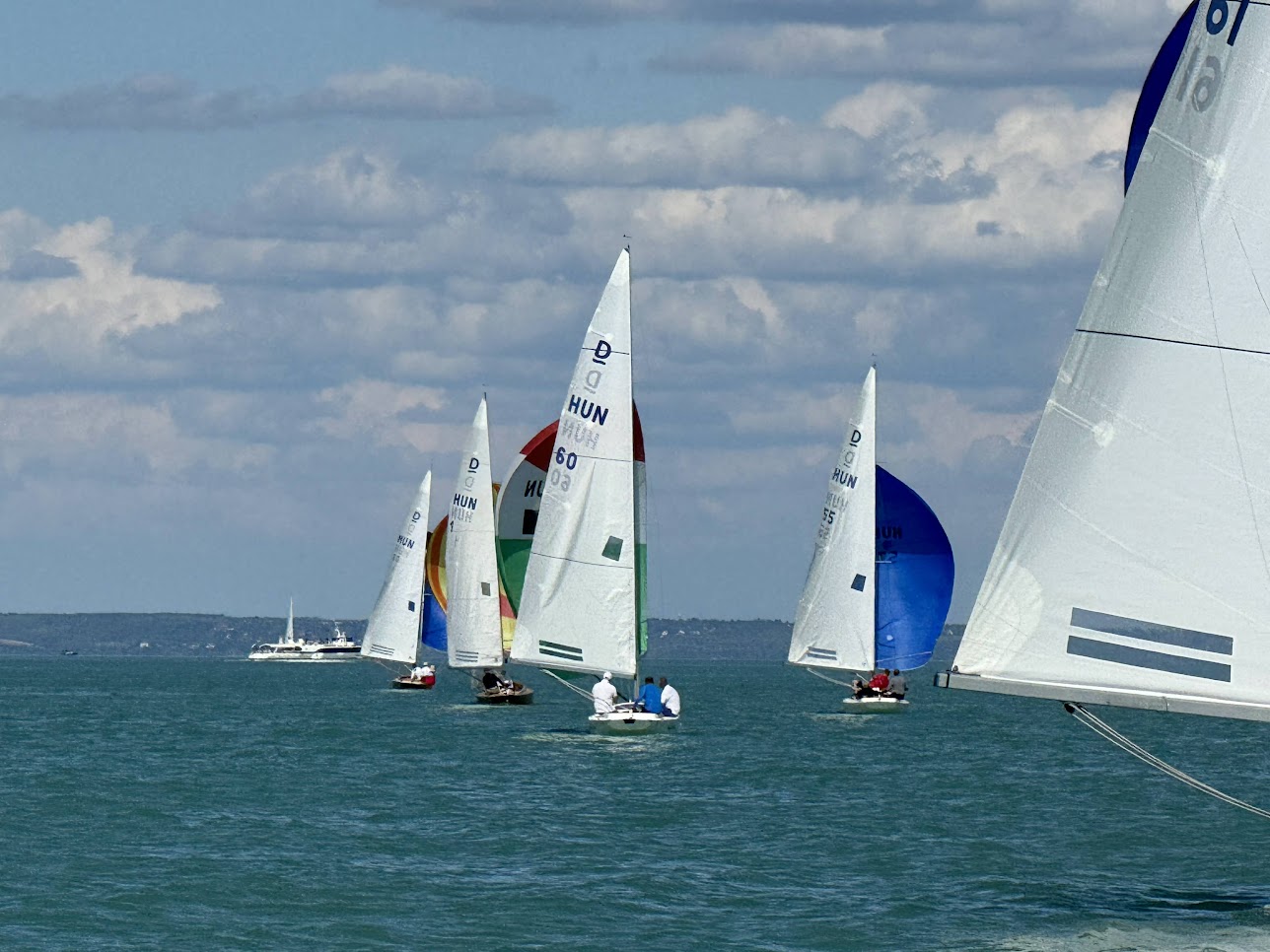
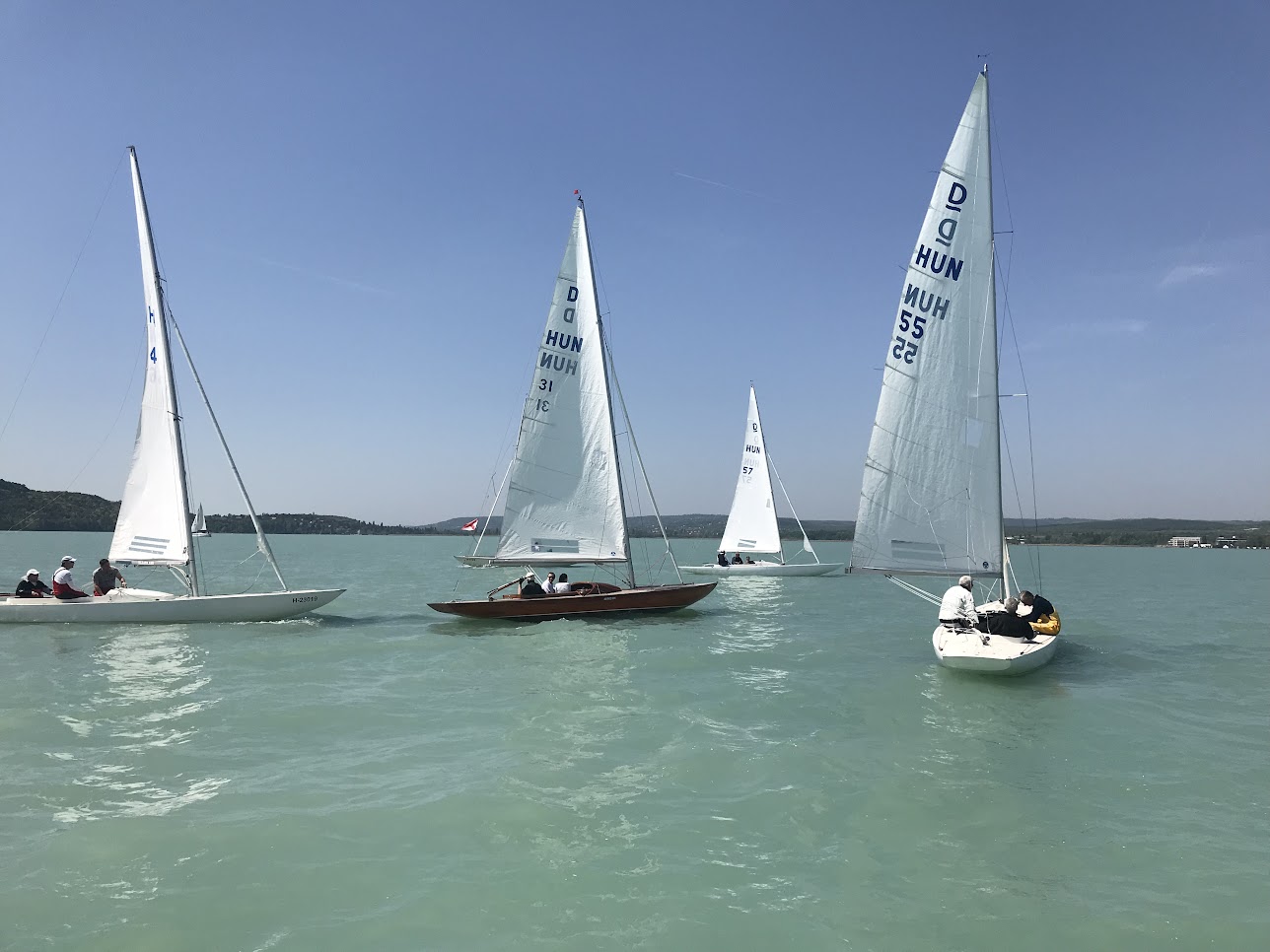
- Jenő Hankóczy with his METEOR (first president of HYC)
- Dr. Miklós Antal with HELGA E 30, first secretary of the Club
- Mihály Antalfy with tour dinghy 25
- Jenő Benacsek /later Hankóczy/ with a 50 KALAND capital ship
- Dr. Zoltán Berzsenyi with a 40-weight cruiser
- Deér Ödön KABALA II. with a 30 m cod-weight cruiser
- Dr. József Deér and his wife with a VIKING 25 touring dinghy
- Ervin Halász from Dabasi with a MACKÓ 25-cc touring dinghy
- János Grofcsik with SIROCCÓ E 30 capital cruiser, (first captain of the Club)
- Gáborjáni József /Reiner/ KLÁRI with 14 jollé
- Gallus Ernő KARAKÁN I. with a 22-weight cod
- Ferenc Káldy with KARI 22, then DÉLIBÁB 50 capital weight boat
- Dr. KeményGyőző GYEREVELEM with jollé 22
- László Kerényi with a ZULU 22 cod-weight cruiser
- Krayer-Kraus Arnold és felesége LUCIFER I. 22-es majd később LUCIFER II. 30-as cirkálóval
- Krayer-Kraus Erich BOZÓ with a 30 m cod-weight cruiser
- Krayer-Kraus Hilda as crew, especially on LUCIFER I
- Lajos Kerekes with LIDÉRC motorbike
- János Iklódi Szabó and sons with a SÓLYOM 30 cod-weight cruiser
- Jalsovicky Lajos NYÍL with a 22 cod-weight cruiser
- Kaposi with /Klaszek/ Ödön jollé
- Mátyásfalvi with Erik Glatz jollé
- Dr. György Matolai with tour dinghy 25
- Otto Henger and his wife as crew
- Heinrich Tibor FABABA I. jolle, KISANGYALOM dinghy 22, KÉKMADÁR with 30 cod-weight cruiser
- Rezső Ocskay with tour dinghy 25
- János and Ferenc Thurner from Sopron as crew
- István István Skodai /Schuler/ with EMESE 30 capital cruiser
- István István Skodai /Schuler/ with EMESE 30 capital cruiser
- Béla Szalkai with a 30 m cod-weight cruiser
- Dr. Tuss Miklós 22-es, majd 30-as tőkesúlyos cirkálóval, utoljára TALIZMÁN 6 R yachttal
- His plans for Kálmán jollé
- Weis Vilmos with E 30 cod-weight cruiser
- Zettl Ágoston as crew
Among them we have to highlight János Grofcsik, Dr. Miklós Tuss, Tibor Heinrich, Ferenc Káldy, who have been champions of their boat classes for years.
After the change of regime in 1989, the Balatonfüred plant was still owned by the BKV. In 1997 it was privatised and the BKV Előre SC was dismissed from the site. The fate of the site was uncertain until 2002, when it was returned to the hands of sailors. The Hungária Yacht Club was re-established on 17 July 2004 under the chairmanship of Lóránd Gömbös
Thanks to the conscientious work of Rudolf Andorka and his contacts, Swiss investors were found and a new club was designed to meet the needs of the times. Construction started in 2006, based on the plans of architect Ferenc Répássy (also a sailor).
Unfortunately, the original clubhouse was demolished in 2007, as it was in a very bad condition and did not really meet the needs. The new buildings were completed in 2008.
The 2008 racing season (as in the old days) started with the club members’ own boats. Currently the following boats are racing in HYC colours:
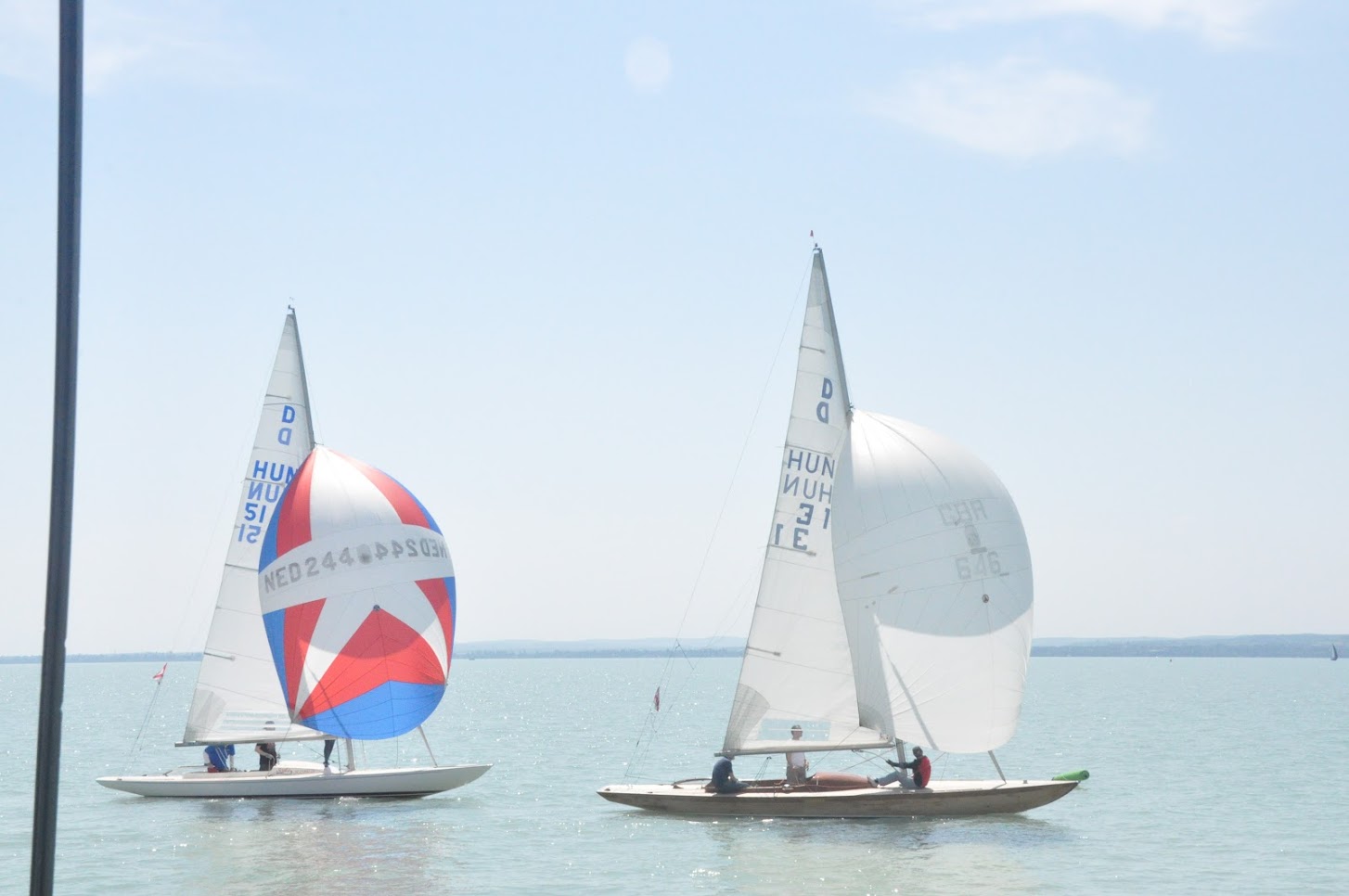
- "Madicken" DB1 34 foot 3.5 t racing boat
- "Buldog" Börensen racing cruiser
- „Josephin” Sudár Regatta
- Racing cruiser "Manöken" 30
- "Ultramarine" competition dragon
- "Jampec" competition dragon
- 1 pirate




Gallery